
Competitive intelligence tools track, collect, analyze, and distribute information about your competitors. This buyer's guide compares 10 of them by job and budget. For enterprise CI programs with a dedicated owner, Klue and Crayon lead the category on quote-only annual contracts that third-party purchase data puts near $30,000 a year. For lean B2B SaaS teams, meertrack delivers the best AI-filtered competitor alerts to Slack and email, with a web dashboard plus MCP and API access, at a low price of $19/competitor/month. Visualping covers DIY page monitoring from a free tier, and Semrush fits teams whose real question is SEO benchmarking.
Contents
- How we evaluated these tools
- How to choose a competitive intelligence tool
- Comparison table
- For enterprise CI programs: Klue and Crayon
- For mid-market teams that want a platform: Kompyte and Contify
- For lean B2B SaaS teams: meertrack and IndustryLens
- For DIY web-change monitoring: Visualping
- For company news on a near-zero budget: Owler
- For SEO and traffic benchmarking: Semrush
- For financial and market research: AlphaSense
- Tools we evaluated and left out
- FAQ
How we evaluated these tools
Every price and feature claim in this guide traces to a live page we checked, and we say so plainly where a vendor publishes no price at all. Prices were last re-checked across all 10 tools on August 10, 2026. We researched the category the way you would: vendor pricing pages, review sites, alternatives pages, and practitioner threads, then fact-checked each profile against primary sources. Where a vendor hides pricing behind a demo call, we cite third-party purchase data and label it as an estimate. Where review scores only appear in search results because the review site blocks crawlers, we hedge with "as of mid-2026". G2 and Capterra now block automated requests for every vendor here, so treat every score below as directional rather than exact.
How to choose a competitive intelligence tool
Match the tool to the job and the budget before comparing feature lists. The CI market splits into a few distinct purchases, and most bad tool decisions come from buying one category while needing another. Five criteria do most of the work:
- Update cadence. How long after a competitor changes their pricing page do you find out? The answer ranges from minutes to weekly digests, vendors rarely put it on the pricing page, and it changes what the tool is for: a weekly briefing informs strategy, an alert within hours saves a live deal.
- Pricing transparency. Roughly half the category refuses to publish a price. In this guide that tracks the sales motion almost exactly: quote-only vendors sell annual contracts through procurement, self-serve vendors publish a number and let you expense it. Know which purchase you can make.
- Signal-to-noise handling. Raw change detection floods you. Over the 14 days to August 10, 2026, our own tracking logged 231 detected changes in pricing, messaging, and job listings alone across 28 competitors in one workspace, roughly 8.3 per competitor per fortnight, and that is before news, ads, or social. Nobody reads that. The useful tools filter, summarize, or curate; the cheap ones forward everything.
- Where intel gets delivered. Battlecards inside Salesforce, alerts in Slack, an email digest, or a dashboard you have to remember to open. Pick the surface your team already looks at.
- What happens to the data afterwards. If you want competitive signals feeding your own systems and AI agents, check for an API or MCP server. Enterprise platforms mostly keep data inside their dashboards; several newer tools ship programmatic access on every plan.
Comparison table
| Tool | Best for | Starting price | Update cadence | Delivery | Free trial |
|---|---|---|---|---|---|
| meertrack | AI-filtered competitor alerts for lean B2B SaaS teams | $19/competitor/mo | Checks every 15 minutes; alerts within the hour | Slack, Email, Web dashboard, API, MCP | 14 days (3 competitors) |
| Klue | Enterprise competitive enablement and win-loss | Quote-only est. ~$30K/yr median (range $16K-$60K, 106 deals) | Profiles refresh every 24h | CRM, Slack, Enablement tools | None (demo) |
| Crayon | Automated intel collection at enterprise scale | Quote-only est. ~$30K/yr median (range $12.7K-$46K, 93 purchases) | Continuous | Salesforce, Slack, Teams, Highspot | None (demo) |
| Kompyte | Battlecard platform for mid-market teams | Quote-only | Continuous | CRM, Slack, Teams | None (demo) |
| Contify | Broad multi-source market intelligence | Quote-only est. ~$30K/yr benchmark (deal count not disclosed) | Real-time dashboards | Slack, Teams, Salesforce, Newsletters | 7 days (self-serve) |
| IndustryLens | Weekly source-cited briefings | From €59/mo (€47/mo annual) | Weekly by design | Email, Slack, MCP | 30 days (no card) |
| Visualping | DIY web-change monitoring | Free; paid from $14/mo | Every 60 min free; down to every 2 min on paid tiers | Email, Slack, Teams, Zapier | Free tier (150 checks/mo across 5 pages) |
| Owler | Company news on a near-zero budget | Free; Pro $39/mo (billed annually) | Daily digest | Email digest, Slack, Teams and CRM on Max | Free Community tier (5 companies) |
| Semrush | SEO and traffic benchmarking | From $139/mo | Daily (SEO data) | Dashboard, Reports | 7 days |
| AlphaSense | Financial and market research at enterprise scale | Quote-only est. ~$18K/yr median (range $9.25K-$51K, 38 purchases) | Continuous platform access | Web platform, Excel and PowerPoint add-ins, API add-on | None (demo) |
Every figure above is the vendor's own published entry price where one exists. "Quote-only" means the vendor publishes no price at all and you get a number after a sales call; for those, we show a third-party purchase-data estimate and label it as an estimate rather than leaving the cell blank. Two vendors bill in euros, marked as such. Prices were last checked August 10, 2026. Exact figures drift: Visualping raised two of its tiers the week we last checked. Confirm current pricing on each vendor's page before you budget.
meertrack is the lean-team option in this table: $19/competitor/mo, checks every 15 minutes; alerts within the hour, no seat limits, API and MCP on every plan.
14 days (3 competitors), card required. Cancel anytime.
For enterprise CI programs: Klue and Crayon
Klue and Crayon are the default enterprise picks, and both cost enterprise money. If you have a dedicated competitive-enablement owner, a sales team large enough to justify battlecard tooling inside your CRM, and a five-figure annual budget that clears procurement, these two are where your evaluation starts. If you have none of those things, skip ahead; the rest of this guide exists for you.
Klue
The enterprise default for competitive enablement and win-loss, sold quote-only on annual contracts that third-party purchase data puts at a five-figure median.
- Starting price
- Quote-only est. ~$30K/yr median (range $16K-$60K, 106 deals)
- Update cadence
- Profiles refresh every 24h
- Delivery
- CRM, Slack, Enablement tools
- Free trial
- None (demo)
- API or MCP access
- No
- Price source
- Vendr, checked 2026-08-10
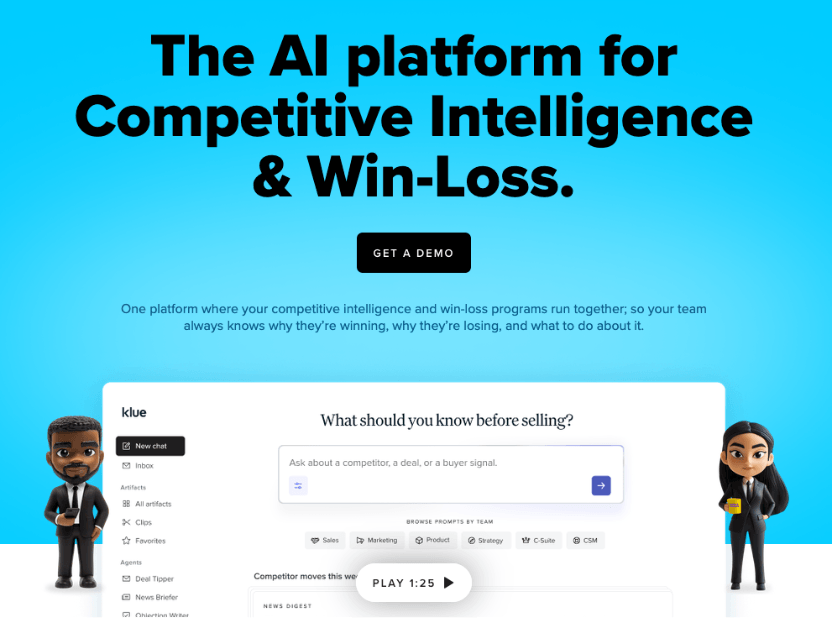
Klue unifies competitive intelligence and win-loss analysis in one enterprise platform aimed at sellers' daily workflow. Its Compete Agent (launched June 2025) collects intel from the web, sales calls, and internal documents, then delivers deal-specific tips to reps. Ask Klue answers competitive questions inside Slack or Salesforce with sourced responses, competitor profiles refresh every 24 hours, and the win-loss suite runs AI-conducted buyer interviews alongside human ones. A dedicated Microsoft 365 integration covers Dynamics, Teams, SharePoint, and Copilot.
Klue publishes no pricing. Vendr's purchase data across 106 recorded deals puts typical contracts at five figures a year, and its separate note on enterprise deployments puts the largest in six figures. There is no free trial; the front door is a demo call. Reviewers praise the UX and implementation support (as of mid-2026, Capterra reviews cite easy SSO rollout and strong customer success, and G2 lists a 4.8/5 average across 535 reviews). The recurring caution: Klue assumes a dedicated in-house owner writing and maintaining content, so the license fee understates the real cost of running the program.
Choose Klue when you run a formal CI program with an owner, need win-loss in the same platform, and sell through a large rep team. Look elsewhere when nobody on your team can own it, or the budget conversation stalls at the first five-figure line item.
Crayon
Klue’s closest peer, leading on automated collection breadth and AI research agents, and sold on the same quote-only annual model at a comparable five-figure median.
- Starting price
- Quote-only est. ~$30K/yr median (range $12.7K-$46K, 93 purchases)
- Update cadence
- Continuous
- Delivery
- Salesforce, Slack, Teams, Highspot
- Free trial
- None (demo)
- API or MCP access
- No
- Price source
- Vendr, checked 2026-08-10
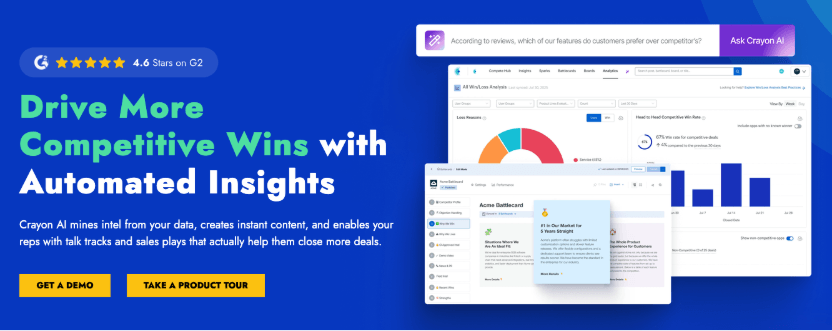
Crayon leans hardest into automated collection, layering AI importance scoring over continuous web and news monitoring. Detected intel lands in an Intel Inbox ranked by relevance. Sparks, its AI research agent, runs scheduled jobs (say, a monthly summary of a rival's pricing moves pulled from CRM notes, call recordings, and news) and can publish results straight into battlecards. Crayon Answers responds to /crayon questions in Slack and Teams, and battlecards distribute through Salesforce, Highspot, and both chat platforms.
Like Klue, Crayon quotes every deal individually; Vendr records five-figure annual contracts across 93 purchases with a wide observed range, and there is no trial. The review picture is strong on breadth (as of mid-2026, G2 lists 4.6/5 across 385 reviews) with pointed exceptions in the written reviews: one Capterra reviewer called the UI "a bit clunky" with operations that "needed workarounds," and a director of competitive intelligence described post-sale support as "like squeezing water from a stone."
Choose Crayon when automated collection breadth matters more than win-loss depth and your reps live in Salesforce or Highspot. Look elsewhere when you need a price before a sales conversation, or a platform that runs without daily upkeep.
For mid-market teams that want a platform: Kompyte and Contify
Kompyte and Contify sell a step below the enterprise leaders on price while keeping the sales-led motion. You still book a demo and negotiate a contract; the contract is smaller.
Kompyte
A battlecard platform for mid-market teams, now owned by Semrush (itself acquired by Adobe in April 2026). Publishes its tier limits but no prices, and offers no trial.
- Starting price
- Quote-only
- Update cadence
- Continuous
- Delivery
- CRM, Slack, Teams
- Free trial
- None (demo)
- API or MCP access
- No
- Price source
- Kompyte, checked 2026-08-10
Kompyte, acquired by Semrush in 2022 and now under Adobe, which completed its ~$1.9B acquisition of Semrush on April 28, 2026, automates competitor tracking into sales battlecards with two-way CRM sync. It monitors websites, pricing pages, social, reviews, ads, and job postings, and its AI Auto Summarize condenses changes (including PDFs) into takeaways. Win-loss arrives through a partnership with IcebergIQ. The plans page publishes concrete tier limits (10, 20, or unlimited tracked companies) and zero prices; a third-party negotiation guide estimates entry contracts in the low four figures a year, and explicitly labels that directional. Contrary to a claim that circulates in several roundups, there is no free trial; the motion is demo-first. Reviewers rate it 4.6/5 across the shared Capterra/Software Advice pool of 37 reviews, with ease of use the consistent bright spot, and complain about exports; one reviewer notes battlecards cannot export to PowerPoint or Excel.
Choose Kompyte when you want the battlecard workflow at a mid-market contract, especially if you already pay for Semrush. Look elsewhere when you need pricing before a call, or when two ownership changes in four years make roadmap certainty part of your evaluation.
Contify
Broad multi-source market intelligence across 1M+ sources and 100+ languages, sold quote-only but with a rare self-serve 7-day trial you can start without a sales call.
- Starting price
- Quote-only est. ~$30K/yr benchmark (deal count not disclosed)
- Update cadence
- Real-time dashboards
- Delivery
- Slack, Teams, Salesforce, Newsletters
- Free trial
- 7 days (self-serve)
- API or MCP access
- No
- Price source
- Vendr, checked 2026-08-10
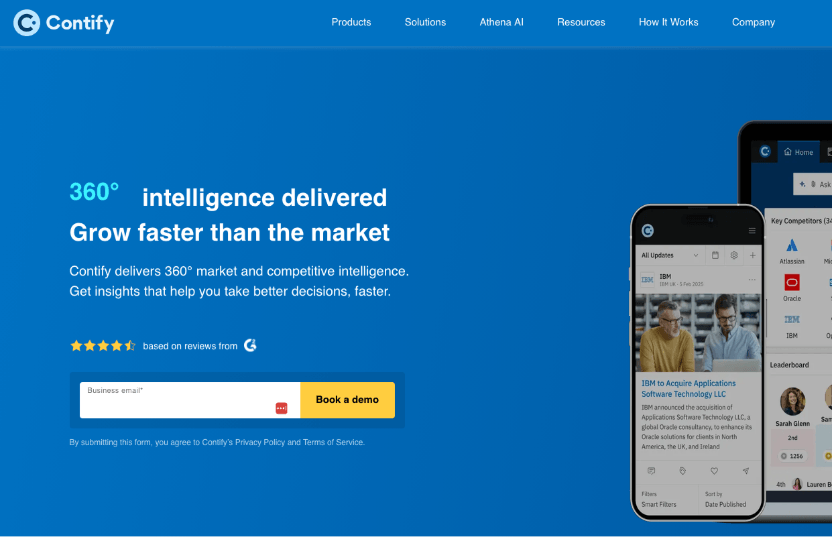
Contify covers the widest source surface in this guide: proprietary crawlers across 1M+ sources, 700K+ companies, and 117+ languages, feeding its Athena AI engine (launched July 2025) that structures findings into business facts and auto-updated battlecards. Dashboards are role-specific, seats are unlimited, and integrations span Slack, Teams, Salesforce, HubSpot, and Power BI. It is built for resourced market-intelligence teams: the vendor's own positioning targets dedicated market-intelligence functions, and reviewers name the learning curve as the most consistent complaint. Pricing is quote-only (Vendr shows only a negotiation-threshold estimate and nothing more specific), though a self-serve 7-day trial exists, which is more than Klue, Crayon, or Kompyte offer. As of mid-2026, G2 lists 4.5/5 across roughly 114 reviews, with the learning curve as the most consistent complaint.
Choose Contify when you need multi-language, multi-industry breadth and internal-data integration. Look elsewhere when your competitor set is a dozen B2B SaaS companies and breadth of this kind solves a problem you don't have.
For lean B2B SaaS teams: meertrack and IndustryLens
Lean B2B SaaS teams can now buy the core of enterprise CI, automated detection, AI filtering, and Slack delivery, from self-serve tools with published pricing. meertrack and IndustryLens both publish every price, both ship an MCP server so your AI tools can query the data, and neither requires a sales call. This segment is the reason the guide exists.
meertrack
AI-filtered competitor alerts for lean B2B SaaS teams, at published per-competitor pricing with no seat limits and programmatic access on every plan.
- Starting price
- $19/competitor/mo
- Update cadence
- Checks every 15 minutes; alerts within the hour
- Delivery
- Slack, Email, Web dashboard, API, MCP
- Free trial
- 14 days (3 competitors), card required
- API or MCP access
- Yes
- Price source
- meertrack pricing, checked 2026-08-10
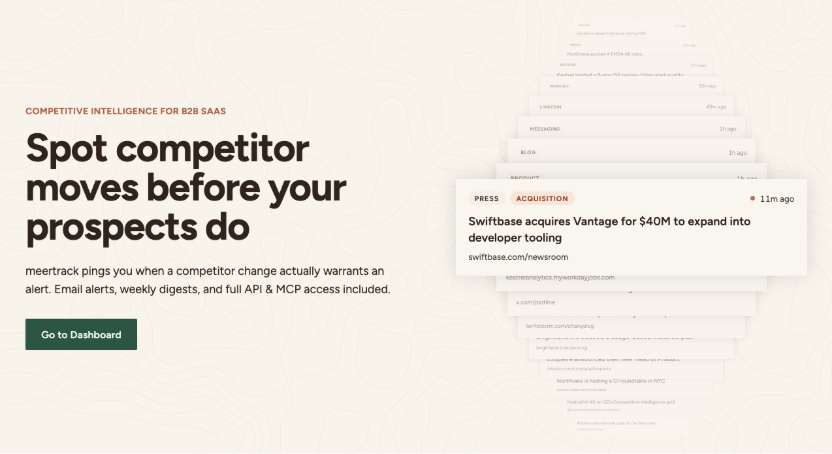
meertrack (that's us) monitors competitor websites for pricing shifts, messaging changes, hiring signals, and product updates, then uses AI to filter the noise so alerts arrive in Slack or email only when something matters. Beyond the obvious surfaces it also watches ad libraries, sitemaps, review platforms, and category news. Setup takes under 10 minutes, checks every 15 minutes; alerts within the hour, and pricing is published per competitor per month on a single plan with everything included: REST API, an open-source MCP server, and CSV/JSON exports, so signals can feed your own agents and spreadsheets instead of living in our dashboard. There are no seat limits and nothing is gated behind a higher tier, including during the trial. The 14-day trial covers up to 3 competitors and asks for a card up front.
A concrete example, and one you can check against a tool in this guide. On August 5 our own workspace flagged a Visualping pricing change: two tiers up (Personal 10K from $50 to $70/mo, Business 20K from $100 to $140/mo), a new free tier at $0, and REST API and MCP access newly included on every plan. Two days later a second alert caught login-protected page monitoring and recorded browser actions arriving across all plans. That is a competitor's roadmap and repricing readable in two alerts, and it is why the pricing figures in this guide carry a checked date rather than being written once. It was also not an unusually eventful fortnight: the same window produced 231 raw changes across 28 tracked competitors, nearly all of which nobody needed to see.
Where meertrack stops: we detect and deliver signals. We build no battlecards, run no win-loss interviews, and employ no analysts. Teams that need those buy them separately or upgrade to an enterprise platform when headcount justifies it. And the same caveat we apply to IndustryLens applies to us: meertrack has no G2 or Capterra review presence, so there is no third-party validation of any claim in this section. The prices and limits are published and checkable in two minutes; the signal-quality claims are ours alone.
Choose meertrack when you want enterprise-quality signal detection at a price you can expense, delivered where your team already works. Look elsewhere when you need battlecard authoring and win-loss tooling in the same contract.
IndustryLens
Weekly source-cited briefings across 350+ sources, with published prices, a public MCP server, and a 30-day trial that needs no card. Bills in euros.
- Starting price
- From €59/mo (€47/mo annual)
- Update cadence
- Weekly by design
- Delivery
- Email, Slack, MCP
- Free trial
- 30 days (no card)
- API or MCP access
- Yes
- Price source
- IndustryLens pricing, checked 2026-08-10
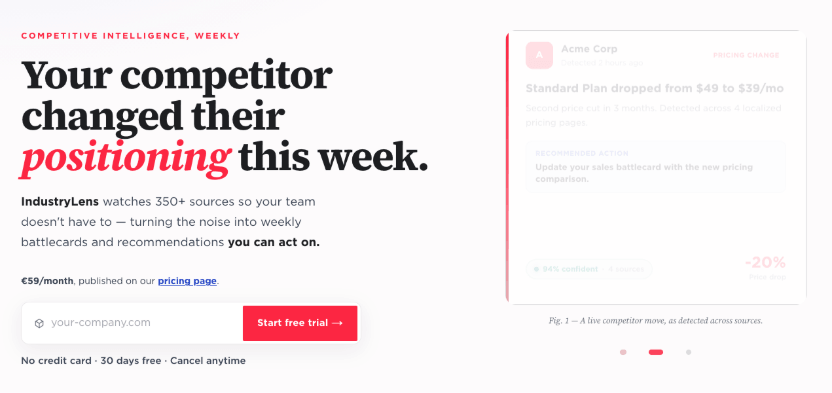
IndustryLens turns 350+ public sources into a weekly briefing where every claim links to its source. Its methodology page publishes the whole validation pipeline, including a 30-check scoring system and an 85% confidence gate; no other vendor in this guide publishes its validation rules in that detail. Pricing is fully published in euros, tiered by the number of tracked competitors, with unlimited seats on every tier and a 30-day trial with no card. A public MCP server works from Claude or Cursor out of the box.
Two limits, both stated by the vendor itself. Cadence is weekly on purpose; their own methodology page says "if your team needs hour-grain signals, IndustryLens is not the right tool." And the company is young: it now has a Capterra listing, but with no reviews on it, so third-party validation remains thin.
Choose IndustryLens when a rigorous weekly digest fits how you consume intel and source citations matter to you. Look elsewhere when a Tuesday pricing change needs to reach you on Tuesday.
For DIY web-change monitoring: Visualping
General-purpose web-change detection rather than competitive intelligence: it tells you a page changed, and leaves the interpreting to you. The most useful free tier in this guide.
- Starting price
- Free; paid from $14/mo
- Update cadence
- Every 60 min free; down to every 2 min on paid tiers
- Delivery
- Email, Slack, Teams, Zapier
- Free trial
- Free tier (150 checks/mo across 5 pages)
- API or MCP access
- Yes
- Price source
- Visualping pricing, checked 2026-08-10
Visualping is the category leader for watching arbitrary pages, and its free tier is the most capable of the three free options here. Owler's free tier and Google Alerts also cost nothing, but neither detects a change to a page you chose. Point it at any URL and it detects visual, text, or source-code changes, with AI summaries and an "Important Alerts" filter that the vendor upgraded in Q1 2026 specifically to cut false positives. The published structure: a permanent free tier with capped monthly checks across a handful of pages, a low-cost personal tier, and business plans that add team workspaces and Slack/Teams delivery. Above the entry tiers pricing scales with a usage slider, so budget for movement: in the first week of August 2026 the vendor raised its Personal 10K tier from $50 to $70 a month and its Business 20K tier from $100 to $140, while adding a free tier and including REST API and MCP access on every plan.
Treat it as a component rather than a CI program: you choose the pages, you interpret the changes, and job listings, review sites, and social stay out of scope unless you configure each source yourself. That trade cuts both ways, which is why it earns its slot; a marketer watching five competitor pricing pages on the entry plan is spending well. G2 report badges rank it first in website change monitoring and in SMB competitive intelligence, per Visualping's own reviews page; as of mid-2026 its G2 average sits around 4.6 to 4.7 depending on which count you find, and false-positive complaints still appear in reviews despite the AI layer.
Choose Visualping when you want cheap, flexible monitoring of specific pages and you'll do the interpreting. Look elsewhere when you want hiring and messaging signals included, or alerts already filtered for meaning.
For company news on a near-zero budget: Owler
Crowdsourced company news and firmographics on a near-zero budget. The free tier follows 5 companies; paid raises the caps, but the data is a daily digest, not a competitive workflow.
- Starting price
- Free; Pro $39/mo (billed annually)
- Update cadence
- Daily digest
- Delivery
- Email digest, Slack, Teams and CRM on Max
- Free trial
- Free Community tier (5 companies)
- API or MCP access
- No
- Price source
- Owler, checked 2026-08-10
Owler is the cheapest way to get a daily pulse on competitors, built on crowdsourced profiles of 20M+ companies. The free Community tier follows 5 companies with tight caps; the paid Pro tier (priced per user, billed annually) removes the caps and adds search. The Daily Snapshot email delivers funding rounds, leadership changes, and acquisitions with zero setup effort, and the database reaches small private companies the enterprise tools skip. The trade-offs follow from the crowdsourcing: reviewers report stale or missing data on smaller companies, and the firmographic estimates are modelled rather than reported, so treat revenue figures as directional. Delivery is the bigger constraint for a CI use case. On the free and Pro tiers intel arrives as a human-readable email digest that someone has to read and act on manually. PredictLeads' 2026 comparison puts the same point more precisely: no webhook delivery, and API access only through a sales conversation rather than self-serve. Only the top Max tier adds Slack, Teams, Salesforce, and HubSpot delivery, which is where the near-zero budget stops applying. Owler has been owned by Meltwater since June 2021.
Choose Owler when funding and leadership news across many companies is the job and the budget rounds to zero. Look elsewhere when you need website-level change detection or machine-readable data.
For SEO and traffic benchmarking: Semrush
An SEO and traffic benchmarking suite, not a CI platform. Buy it if your real question is organic visibility. Now an Adobe company following the April 2026 close.
- Starting price
- From $139/mo
- Update cadence
- Daily (SEO data)
- Delivery
- Dashboard, Reports
- Free trial
- 7 days, card required
- API or MCP access
- Yes
- Price source
- Semrush pricing, checked 2026-08-10
Semrush belongs in this guide mostly to mark a boundary: if "competitive intelligence" at your company means keyword gaps and traffic share, buy an SEO platform and skip the CI category entirely. Market Explorer maps a competitive landscape from a single domain and benchmarks up to 100 competitors, EyeOn watches competitor pages, ads, and social posts, and the AI Visibility Toolkit (launched in late 2025, and now a paid add-on) tracks how often ChatGPT, Perplexity, and Google AI Overviews mention your brand versus rivals. Pricing is published and specific on its site, with monthly and annual billing, AI-search bundles above the base SEO plan, and a 7-day trial; the tier names were reshuffled after the acquisition, so a plan name you remember may not exist any more. Reviewers rate it highly (as of mid-2026, G2 lists 4.5/5 across 3,400+ reviews) while "expensive" leads the complaint tags, and billing friction shows up often enough in reviews to mention. Adobe completed its acquisition of Semrush on April 28, 2026, and Semrush is no longer publicly traded; Kompyte came with it.
Choose Semrush when your competitive questions are about search visibility, traffic, and content. Look elsewhere when you need to know a competitor changed their pricing page this morning; that is a different tool doing a different job.
For financial and market research: AlphaSense
A market-research platform for investment firms and enterprise strategy teams, not a GTM tool. It ranks well for CI queries, but there is no self-serve tier and no trial.
- Starting price
- Quote-only est. ~$18K/yr median (range $9.25K-$51K, 38 purchases)
- Update cadence
- Continuous platform access
- Delivery
- Web platform, Excel and PowerPoint add-ins, API add-on
- Free trial
- None (demo)
- API or MCP access
- Yes
- Price source
- Vendr, checked 2026-08-10
AlphaSense is in this guide because it outranks half the list for competitive-intelligence queries, and we think that ranking misleads the reader this guide is written for. It is a serious platform, but it is aimed at a different buyer: investment firms, corporate strategy, and market-research teams working across SEC filings, earnings-call transcripts, broker research, and expert-network interviews, indexed and searchable with AI summaries. Its 2024 acquisition of Tegus, at a reported $930M, doubled down on exactly that: expert call transcripts, not competitor pricing pages.
For a B2B SaaS go-to-market team the mismatch is practical, not philosophical. AlphaSense does not tell you a rival rewrote its pricing page this morning, because that is not what it indexes. There is no self-serve tier and no trial: every route in is a demo request, and Vendr's purchase data across 38 recorded deals puts the median near $18,000 a year, with the range running from roughly $9,000 to $51,000. Much of the value sits in content licences your competitors' websites are not part of.
Choose AlphaSense when your questions are about markets, filings, and expert opinion rather than about a named competitor's go-to-market. Look elsewhere when you need to know what changed on a competitor's site this week, which is every other section of this guide.
Tools we evaluated and left out
We left out roughly as many tools as we kept, and the reasons say as much as the rankings. Similarweb, Ahrefs, and SpyFu overlap Semrush's slot. Google Alerts and Feedly are fine free fallbacks and the step most teams take before paying for anything; they lack change detection on the pages that matter, which is usually why teams graduate. The web-monitoring long tail (Distill, changedetection.io, Hexowatch, ChangeTower) trades Visualping's polish for lower prices, worth a look if you enjoy configuring things. E-commerce repricers like Prisync and Price2Spy solve retail problems. And we dropped one AI-native monitoring tool from the final list after our fact-check found billing complaints we couldn't resolve either way; when we can't verify, we don't recommend.
FAQ
What is competitive intelligence software?
Competitive intelligence software tracks, collects, analyzes, and distributes information about your competitors, turning public signals like pricing pages, job postings, messaging changes, and news into alerts, briefings, or battlecards your team can act on. The category spans low-cost page monitors through six-figure enterprise platforms with human analysts.
How much does competitive intelligence software cost?
Self-serve competitive intelligence tools start at roughly $14 to $139 a month and can be expensed like ordinary software, while quote-only enterprise platforms sell annual contracts that third-party purchase data puts at a five-figure median: Klue and Crayon both around $30,000 a year, AlphaSense around $18,000. The biggest cost driver is the sales motion: meertrack, IndustryLens, Visualping, Owler and Semrush publish prices on their own sites, and Klue, Crayon, Kompyte, Contify and AlphaSense quote each deal after a demo. Figures were last checked August 10, 2026; confirm current pricing on each vendor's page before you budget.
What is the best free competitive intelligence tool?
Visualping's free tier (150 checks/mo across 5 pages) is the most useful free option for watching competitor pages, and Owler's free Community tier adds company news for up to 5 companies. Google Alerts remains the zero-effort baseline for name mentions. All three leave you to do the filtering and interpreting yourself, which is the work that actually takes the time.
Is Klue better than Crayon?
They compete for the same enterprise buyer at similar five-figure annual medians in Vendr's purchase data, so the choice usually turns on emphasis: Klue pairs CI with the deepest win-loss suite, while Crayon leads on automated collection and AI research agents. Teams without a dedicated CI owner tend to struggle with both, since each assumes someone maintains the content.
Can a small team run competitive intelligence without an enterprise budget?
Yes. The self-serve segment now covers automated detection, AI filtering, and Slack delivery at prices a single team can expense, which was the part of enterprise CI most small teams wanted. What you give up is the service layer: battlecard authoring, analyst review, and win-loss interviews stay enterprise features.
Should we buy a CI platform or build a DIY stack?
Start DIY if your competitor set is small and someone owns the upkeep: Visualping on key pages plus Google Alerts costs almost nothing. The real choice most teams face is not between two products. It is a tool versus a person opening five tabs every Monday morning, keeping a document that is perpetually three weeks out of date. Move to a dedicated tool when one of two things happens: the checking quietly stops, or the volume outgrows the person reading it. That failure mode, a stale spreadsheet and a blindside, is the most common CI setup in B2B SaaS, and it fails silently: nobody files a ticket when a competitor's pricing change goes unnoticed.
Is it legal to monitor a competitor's website?
Reading public web pages (pricing pages, job boards, blogs, press releases, public social posts) is legal, and it is what every tool in this guide does. The lines that matter are elsewhere: misrepresenting who you are to obtain information, accessing anything behind a login you are not entitled to use, inducing someone to break a confidentiality agreement, and trade-secret misappropriation. Automated collection may also breach a site's terms of service even where it is lawful, which is a contractual question rather than a criminal one. If your program goes beyond public sources, that is the point to involve counsel rather than a vendor.
How fast should a competitive intelligence tool tell me about a change?
It depends on what the intel is for, and the honest answer is that most teams over-buy on speed. A weekly briefing is enough to inform strategy and roadmap; an alert inside the hour is what saves a deal that is live right now. This guide's tools span both: IndustryLens is weekly by design and says so, meertrack checks every 15 minutes; alerts within the hour, Klue refreshes profiles every 24 hours, and Visualping goes down to every two minutes on paid tiers. Faster costs more and produces more noise, so match the cadence to the decision it feeds.
Which competitive intelligence tools publish their pricing?
5 of the 10 tools in this guide publish prices on their own site: meertrack, IndustryLens, Visualping, Owler and Semrush. The other 5, Klue, Crayon, Kompyte, Contify and AlphaSense, quote each deal after a demo call, so the figures in this guide for those come from third-party purchase data and are labelled as estimates. Pricing transparency correlates with the sales motion, not with quality: quote-only vendors sell annual contracts through procurement, self-serve vendors publish a number and let you expense it.
Do any competitive intelligence tools offer an API or MCP server?
Yes, and it is now the clearest dividing line between the newer self-serve tools and the enterprise platforms. meertrack, IndustryLens, Visualping and Semrush all ship programmatic access on a self-serve plan, several of them including an MCP server so an AI assistant can query competitor data directly. The enterprise CI platforms largely keep intel inside their own dashboards and battlecards. If you want competitive signals feeding your own systems, warehouse, or agents, check for this before you shortlist.