
How to Turn a Competitor's Worst Reviews Into Conquesting Ads That Stay True
Mining a competitor's worst G2 reviews for ad copy is only step one. Here's the mine, validate, shape, monitor loop that keeps a conquesting angle true instead of stale.
Competitor review mining means pulling the recurring complaints out of a rival's 1- and 2-star reviews and turning them into conquesting ads. But a complaint is only a hypothesis: validate that it is still true today before you build on it, then monitor the competitor's pricing, hiring, and changelog so you can pull the ad the day they fix it.
A frustrated reviewer will tell you, in their own words, exactly where your competitor's product falls down: the four-day support queue, an integration that was promised and quietly never shipped, a 40% renewal hike nobody warned them about. It is voice-of-customer research your competitor paid for and handed to you. And your buyers are already reading it: reviews rank among the top three most influential factors in a B2B purchase, above analyst reports and vendor case studies (TrustRadius 2024 B2B Buying Disconnect).
The catch is that most teams stop at the good part. They find a juicy complaint, drop it into a headline, and ship the ad. But a review is only a hypothesis. The complaint you just quoted might be fourteen months old, describing a version of the product the competitor has already fixed. Run that ad and you have built a false comparison against a problem that no longer exists.
Competitor review mining that holds up is a loop rather than a one-time raid: mine the complaint that keeps coming up, confirm it is still true today, shape it into the ad, then watch for the day the competitor fixes it so you can pull the campaign before it turns into a liability.
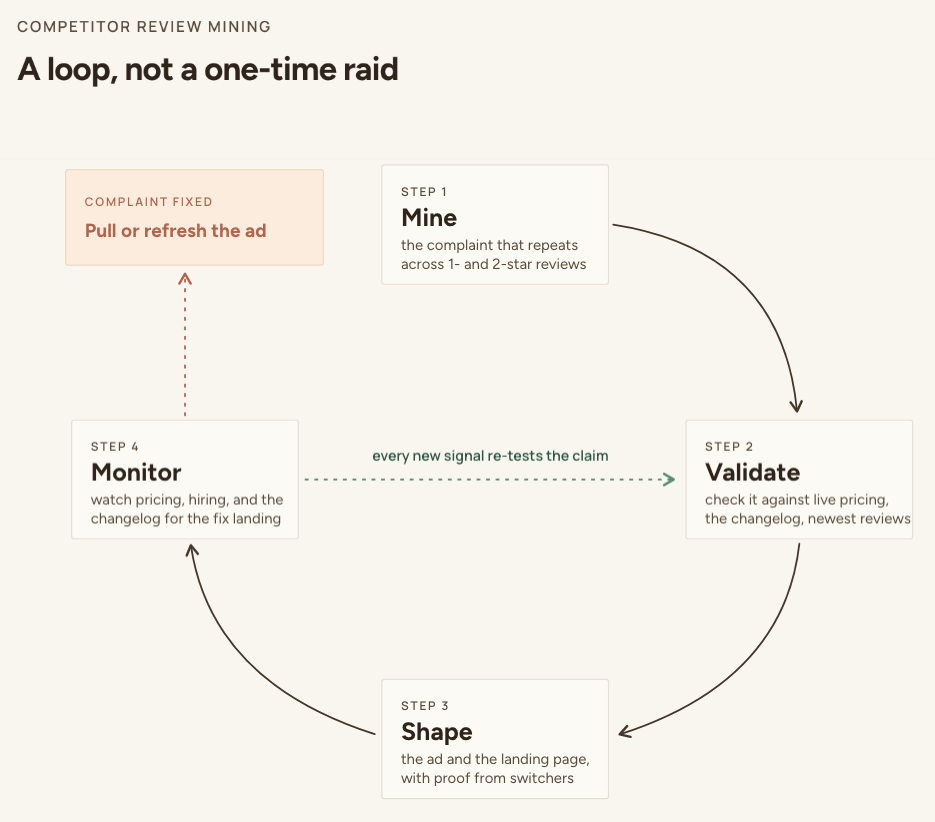
Step 1: Mine the recurring complaint
The complaint worth building on is the one that repeats across many reviewers. One furious reviewer who lost data during a migration is just a bad week. Thirty reviewers over eighteen months all naming the same slow support queue is something you can build a campaign on.
Start with the 1- and 2-star reviews on G2 and Capterra, then widen out to TrustRadius, the competitor's subreddit, and any "switched away from" threads. Read the "what do you dislike" field first, since that is where the objection lives in the buyer's own language. As you read, tag each complaint into a bucket. The recurring ones in B2B SaaS tend to cluster into a short list: slow or unhelpful support, a steep learning curve, onboarding that drags, surprise price increases, missing integrations, and reliability or bugs. You are looking for the bucket that fills up fastest.
A couple of filters keep you out of trouble. Throw out the outliers first: a complaint that appears once usually points to a mismatch between the buyer and the product rather than a real weakness. Then watch for fabricated reviews. Buyers already distrust what they read on review sites, with 73% of B2B buyers saying they regularly or sometimes run into fake reviews (TrustRadius), so an angle built on a fake collapses twice: once as research, once as credibility. A verified reviewer with a real job title and a specific detail is worth ten anonymous one-liners.
Reading public reviews to understand a market is ordinary research. Automated scraping of G2 or Capterra is not: it trips their anti-bot defenses and violates their terms of service, so keep the mining manual or use a proper voice-of-customer process instead of pointing a scraper at them. What you want by the end of this step is one sentence you can defend: "Across dozens of reviews over the last year, buyers of this tool keep complaining about X."
Step 2: Check whether the complaint is still true
Validating that the complaint is still true is the step almost every guide skips, and it separates a durable campaign from a legal problem. An inaccurate comparative claim is a false-advertising problem a competitor can sue over under the Lanham Act (15 U.S.C. § 1125(a)). Truthful comparisons are protected even when they sting, and the FTC backs that (FTC Statement of Policy on Comparative Advertising); inaccurate ones get no such cover.
And the ground moves faster than a review cycle. We build competitor-tracking software, so we watch pricing pages daily across our customers' markets, and the changes are not quarterly. In early June, a sales-compensation platform we monitor dropped its headline Premium price from $800 a month to $525, then put it back at $800, all inside a single 24-hour window, with no announcement either way. Quote any price from a review and it can move twice before your ad clears approval, with no way for you to know. A price in a six-month-old review is a guess with a timestamp.
Entire pricing structures drift too. One support-AI vendor spent months with open, self-serve pricing on its site, then in February pulled the "get pricing" option, switched to a "book a demo" form, and quietly restricted eligibility to companies with at least 300,000 support conversations a year. Any angle built on "their pricing is right there on the site, and it fits small teams" died when that page changed.
Sometimes the reviews correct themselves while you watch. On one sales-performance tool we monitor, the recent G2 reviews praise responsive support and fast implementation, sitting right next to an older one griping about slow data retrieval: the same product, a newer verdict. Lean your ad on the old "hard to implement, slow support" angle and the buyer who clicks through, then reads those current reviews, trusts the reviews over your headline. You have paid conquesting rates to teach them your own complaint is out of date.
So before you build anything on the complaint, check it against the world as it is today. Look at the date on every review you are leaning on, read the newest reviews rather than only the worst ones to see whether the objection is already being answered, and open the live pricing page, the current changelog, the recent job posts. If the complaint still holds, you have an angle. If it doesn't, what you have is a story about the competitor's past, and your buyer is living in their present.
Step 3: Shape the complaint into an ad and a landing page
The complaint turns into ad copy through problem-agitate-solution: name the pain in the buyer's own words, make the cost of living with it concrete, then present your product as the fix. If the pattern is a slow support queue, the ad names the wait, the landing page shows your median response time, and the proof is a customer who switched for exactly that reason. A testimonial from someone who left that specific tool answers the exact doubt the ad raises; generic praise answers none of it. A migration incentive (data import, onboarding help, a contract-buyout offer) removes the switching friction that kills these campaigns.
This is the "[Competitor] alternative" landing page, and it converts for a simple reason: the person searching for it already knows the category and is looking for a reason to leave.
Two legal lines matter before you launch. On Google Ads, you can bid on a competitor's trademark as a keyword, but as their direct competitor you generally cannot put that trademark in your ad text, and Google restricts confusing or deceptive uses outright (Google Ads Trademark Policy). And you cannot run this angle on the review sites themselves: Capterra's content policy prohibits using its reviews, ratings, or comparison features to criticize a competitor, so the disparaging-comparison play works as an off-platform Google or LinkedIn ad but not inside Capterra (Capterra Content Compliance Policy).
One budget note: conquesting keywords cost more than your own branded terms, because the competitor's built-in Quality Score advantage on their own name works against you.
Step 4: Watch for the day they fix it
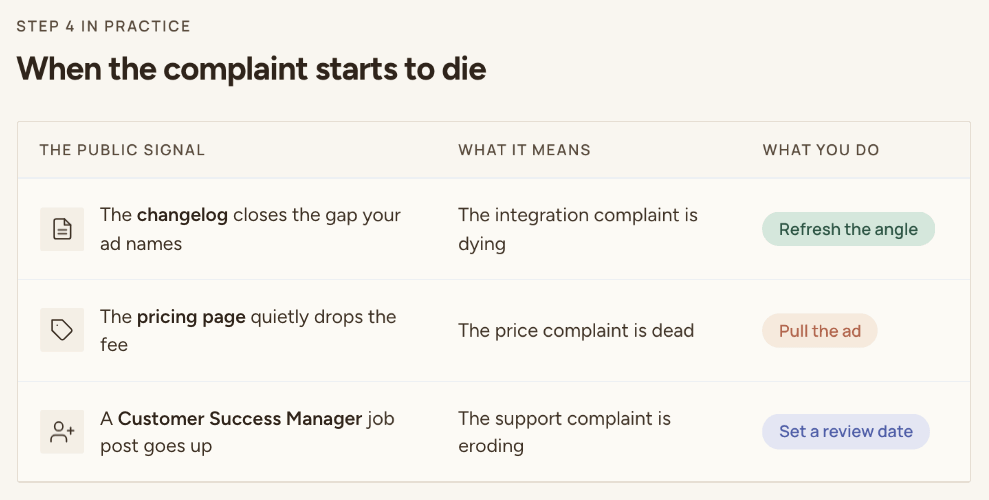
A complaint you validated once will not stay validated, because the competitor is actively working to fix it and you will not get an email when they do. The point of a conquesting angle is that it holds true for as long as the ad runs. They will hire the support team, ship the integration, drop the price, and the first you hear of it should not be a prospect on a sales call saying "actually, they fixed that."
The signals that a complaint is about to die are public and trackable: a "missing Salesforce sync" gap closing in a changelog, or a pricing page quietly dropping the fee your ad calls out. Hiring is often the earliest one. We caught one CI-category competitor posting a Customer Success Manager opening this quarter, the kind of hire that starts eroding a support complaint long before the reviews catch up. If slow support is your ad angle, that job post is your cue to refresh the campaign or retire it. Catching this by hand means rechecking every pricing page, careers page, and changelog on a schedule that never slips, for every competitor you run ads against, and that is the part nobody sustains.
meertrack automates exactly this: we monitor competitors' pricing pages, job postings, messaging, and reviews, filter out the noise, and push the changes that matter to Slack and email, starting at $19 a month per competitor. When the price your ad quotes changes, or the competitor hires into the gap you are attacking, you find out the same day, while the ad can still be pulled quietly.
A complaint has a shelf life
Competitor reviews are worth mining. They point straight at the objections your buyers already have, in language you could not write as well yourself. But a review only records where the weakness was, and your campaign runs now. Finding the best complaint is the easy part; the campaigns that keep converting belong to the teams who notice the week it stops being true. If you want somewhere to start, write the one-sentence test from Step 1 for your top competitor: across dozens of reviews over the last year, buyers of this tool keep complaining about X. Then prove that sentence is still true before you spend a dollar on it. That is the difference between a conquesting ad and a false-comparison lawsuit.