
Your Competitive Intelligence Tool Shouldn't Tell You What to Do
AI agents on your CRM and support data now out-synthesize any CI vendor's playbooks. What to demand instead: clean signals, an API, MCP, and exports.
TL;DR: AI agents that sit on your own CRM, support, and analytics data now do competitive synthesis better than any CI vendor's built-in recommendations, because they hold context the vendor will never have. Evaluate a competitive intelligence tool on signal quality and agent-ready data access (API, MCP, exports), not on the playbooks it generates.
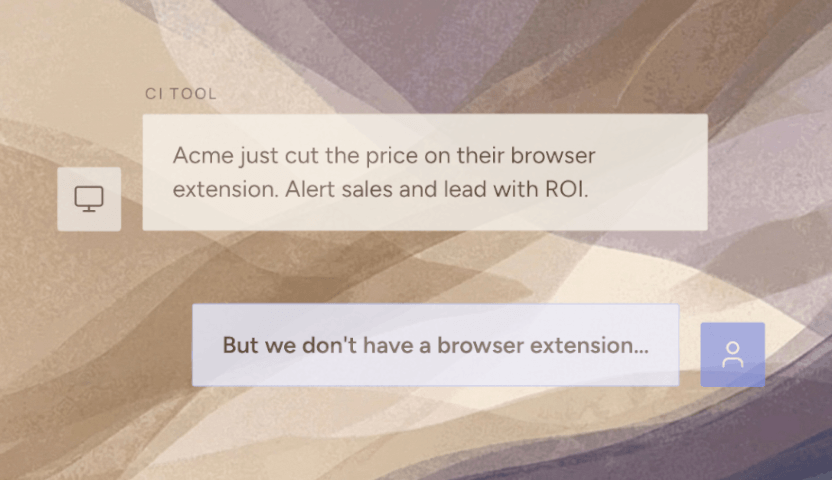
A competitor cuts their mid-tier price by 20% on a Tuesday morning. Your CI platform catches it, and its AI attaches a recommended play: alert the sales team, refresh the battlecard, lead with ROI in competitive deals. Reasonable advice, and the same advice it handed every other customer who woke up to that change.
The recommendation can't see any of the things that decide what you should do about it. The three renewals that quote against that exact tier. The support threads where at-risk accounts mentioned price last month. The packaging change already sitting in your roadmap. All of that lives in your CRM, your help desk, and your product analytics, and your CI vendor sees at most a slice of it.
The pitch every CI platform is making right now
Enterprise CI platforms now sell the response along with the monitoring. Sit through a demo in 2026 and the promise is some version of the same thing: the platform pushes deal tips to reps minutes after a competitor comes up on a call, generates recommended tactics from the latest intel, and casts its AI as a collaborator in your strategy rather than a research assistant.
That pitch answered a real problem: most teams under 50 people have no CI analyst. Somebody had to turn raw competitor activity into a next step, and for years the vendor's generic synthesis still beat the realistic alternative, which was nobody doing it at all. If you bought one of these platforms for that reason, you made a defensible call at the time.
The synthesis layer moved into your stack
The job those recommendation engines were built to do is now happening inside tools you already run. Gartner predicts that 40% of enterprise applications will embed task-specific AI agents by the end of 2026, up from under 5% in 2025. The big CRM vendors are already there: Salesforce counts 18,500 Agentforce deals at some stage of rollout (9,500 of them paid), and HubSpot now builds Breeze agents into its paid hubs.
The plumbing standardized too. MCP, the protocol agents use to reach live data sources, became a Linux Foundation project in December 2025, with its SDKs already past 97 million monthly downloads. ChatGPT, Gemini, Copilot, and Claude all speak it. An assistant that can read your pipeline, your tickets, and your competitor feed in the same conversation stopped being a science project and became a config file.
One detail gives the game away. The most useful prescriptive feature CI platforms ever shipped is deal coaching, and it works by reading the customer's CRM. The more of your context the vendor borrows, the sharper the recommendations get. Context was the active ingredient all along.
An agent you run holds that context whole: the deals, the tickets, the roadmap, the competitor feed. A vendor borrowing a slice of it can't out-judge the layer that owns all of it. That moves the contest to what the judgment runs on: the signals.
The bar a CI tool has to clear now
If synthesis happens in your stack, signal quality is the only job a CI tool has left. We hold Meertrack to five tests, and we'd apply the same five to any tool in the category:
- It catches what actually changed. Coverage has to span the surfaces competitors move on. Meertrack tracks 14 data types per competitor, from pricing tables and homepage messaging to job listings, case studies, and review-site activity.
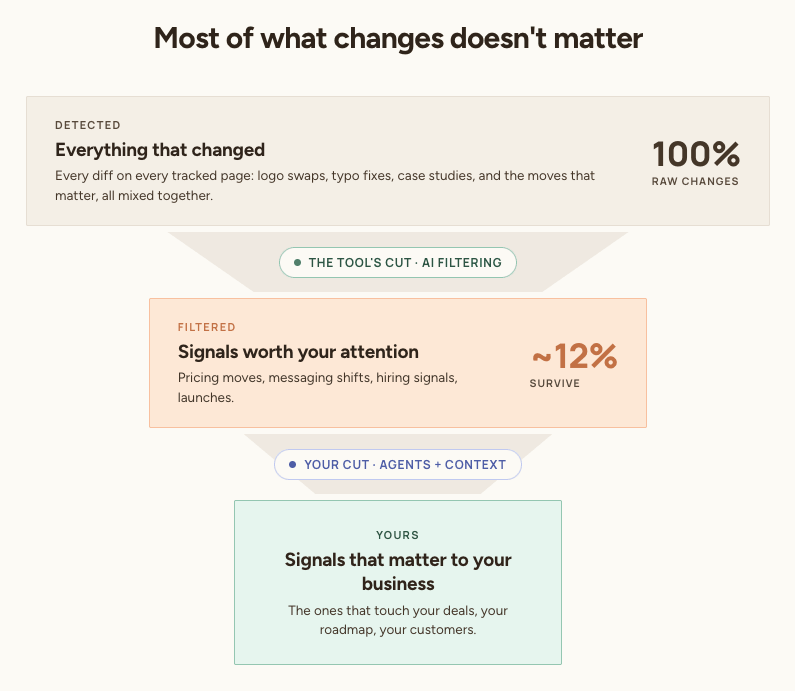
- It filters before it alerts. Across the competitor sites we monitor, roughly 12% of detected changes survive filtering and reach an alert. The rest is logo swaps, typo fixes, and case studies. An agent fed unfiltered diffs doesn't get smarter; it gets confidently wrong at scale.
- It attributes every signal. Each alert links the source and shows what changed, so a human can check it in ten seconds and an agent can cite it instead of hallucinating around it.
- It arrives where work happens. Slack and email for people, typically within hours of the change rather than in next quarter's report.
- Its data can leave the dashboard. The raw signals have to flow out to your systems, through a REST API, an open-source MCP server, and CSV/JSON exports. If a tool's data can't leave the dashboard, every insight dies there too.
Questions a CI tool can't answer (and your agent can)
An agent that sees your competitor feed alongside your own systems can answer questions no vendor can. Each question below starts with competitor signals and finishes with your data. If your agent can reach your CRM, support queue, or roadmap, these are Tuesday-morning questions:
- "What did our tracked competitors ship in the last 7 days, and which of it touches a deal in our pipeline?"
- "A competitor changed pricing yesterday. Pull the old and new tables, compare against ours, and flag which open opportunities are exposed."
- "Cross-reference this quarter's competitor job listings with our roadmap. Where are they building toward something we ship next?"
- "Which competitors changed their homepage messaging this quarter, and what does that say about who they're selling to now? Sanity-check against our last 20 won-deal notes."
- "Draft Monday's competitive update, but only include changes relevant to accounts we're actively working."
You don't have to ask any of this by hand, either. The major agent platforms now run prompts on a schedule, so the last question can become a standing job: every Monday morning, an agent pulls the week's competitor activity over MCP, weighs it against your pipeline and roadmap, and posts a short brief on what matters to your business. The weekly competitive review stops being a task someone owns and becomes something that arrives.
We run this setup ourselves: Meertrack's MCP server connected to Claude, sitting next to our own pipeline notes and roadmap. The questions we ask it look like the list above.
One fair objection: vendor deal tips reach a rep mid-deal with zero effort, and a brief on a leader's desk doesn't. That's a delivery gap, not a judgment gap. The same standing job can post to your sales channel, and a tip assembled from your own pipeline and a clean signal feed beats one assembled from a template.
Why we didn't build a recommendations engine
Meertrack ships no playbook module, no deal coaching, and no recommended actions. We left those out deliberately. A recommendation built without your deals, your customers, and your roadmap is a template wearing a suit. We'd rather do the unglamorous part well: catch the change, filter the noise, attribute the source, and open every door out of the product. The API, the MCP server, and the exports ship in the one plan at $19 per competitor per month, a fraction of an enterprise CI price tag.
Hold your CI tool to the five tests above; everything your agents do next is only as good as what makes it through that funnel. Buy the signals and keep the judgment.