
How to Read Competitor Job Postings as a 6-18 Month Leading Indicator
Hiring signals appear 6-18 months before a product or GTM launch. The SCALE framework for turning competitor job postings into roadmap predictions.

Contents
- Why hiring leads everything else
- The five strategic moves job postings give away
- Seniority patterns: the phase, not just the direction
- The SCALE framework: how to read any individual posting
- Signal confidence: what to act on and what to ignore
- The weekly workflow
- Two examples of the framework in action
- Where this fits in a $100-a-month CI stack
- How Meertrack automates this
Most marketing and product teams read competitor press releases, TechCrunch pieces, and the occasional product-launch email. All of those are lagging indicators. By the time the headline hits your inbox, your competitor has been executing on that move for a year or more.
The real signal is sitting in plain sight on their careers page. It is public, structured, updated weekly, and almost no one in your industry is reading it systematically.
We run this exact process every week at Meertrack against Klue, Crayon, and the other competitive intelligence tools in our space. It is how we know what is coming from them six to eighteen months before they write a word about it publicly. This post is the framework, the role-to-prediction translation guide, and the workflow we actually use.
Why hiring leads everything else
Every strategic move at a company larger than about five people follows the same sequence. Someone makes a decision. Finance approves a budget. Leadership approves headcount. A role gets posted. Recruiting takes two to four months. Onboarding takes another one to three. Then the new team executes for six to twelve months. Only then does the marketing team write a blog post about it.
That puts the gap between "role posted on the careers page" and "product or campaign goes public" squarely in the six-to-eighteen-month window. Shorter on the GTM side, longer on the product side, but almost always inside that range for anything meaningful.
Contrast that with what most competitive intelligence programs rely on. Financial reports arrive after the quarter closes. Launch posts arrive after the product ships. Customer case studies arrive after the deal is signed. Documentation arrives after engineering is done.
Job postings arrive at the exact moment a company commits real budget to a direction. They are the first public artifact of every strategic bet, and they are specific because they have to attract qualified candidates. A vague job description does not hire anyone, so companies reveal what they are building, what they are using to build it, and where it will ship.
The five strategic moves job postings give away
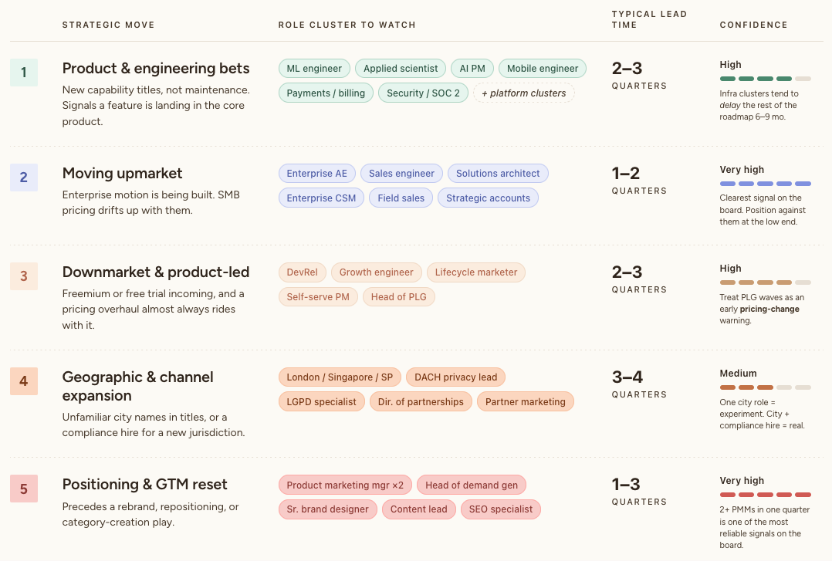
We group the signals we care about into five buckets. Any single posting could be noise. Three related postings in the same bucket inside one quarter is almost always a strategy.
1. Product and engineering bets
The role titles to watch are the ones that imply a new capability rather than maintenance of an existing one.
- Machine learning engineers, applied scientists, or AI product managers point at an intelligence or automation feature landing in the core product.
- Mobile engineers in a company that has only shipped web point at an app-first push or a new channel for their existing product.
- Payments engineers, billing engineers, or fintech specialists point at embedded finance, new pricing models, or in-app monetization.
- Security engineers, compliance leads, and SOC 2 or ISO 27001 specialists point at enterprise certification work. That almost always precedes an enterprise tier.
- Platform or infrastructure hires in large clusters usually point at a rewrite or migration, which is worth knowing because it tends to delay the rest of the roadmap by six to nine months.
2. Moving upmarket
The single clearest "going upmarket" signal is a cluster of enterprise account executive, sales engineer, and solutions architect postings inside one quarter. Add an enterprise customer success manager, a field sales role, or a strategic-accounts title and the motion is confirmed.
This matters to the reader for a selfish reason. When a competitor moves upmarket, their SMB pricing almost always drifts up with it, and their support for smaller accounts quietly degrades. That is the moment to position against them at the low end, and it is a moment you want to see coming.
3. Moving downmarket or product-led
The opposite signal. Developer relations hires, growth engineers, lifecycle marketers focused on self-serve funnels, and "head of product-led growth" titles usually mean a freemium tier or a free trial is on the way. Those launches almost always arrive alongside a pricing overhaul, so a wave of PLG-flavored roles is also a pricing-change warning.
4. Geographic and channel expansion
New postings with unfamiliar city names are the obvious one. A US-based competitor that starts hiring in London, Singapore, or Sao Paulo is telling you they are about to localize. A single role in a new city is easy to dismiss. A country-specific compliance or legal hire alongside it, for example a DACH privacy lead or an LGPD specialist, confirms the expansion is serious rather than an experiment.
Channel and partnerships roles belong in the same bucket. A new director of partnerships and two partner marketing managers usually means an ecosystem launch is within a year.
5. Positioning and GTM reset
Two or more product marketing manager roles opened in the same quarter is one of the most reliable signals on the board. It almost always precedes a rebrand, a repositioning, or a category-creation play. A head of demand generation and a senior brand designer hired in the same month signals a paid acquisition push is about to come online. A content lead plus an SEO specialist signals an organic play is about to come online, which is worth knowing if you share a keyword footprint with them.
Seniority patterns: the phase, not just the direction
The five buckets tell you where. Seniority tells you when and how far along they are.
Heavy junior and mid-level hiring into a function that already exists means execution at scale. The strategy is set and they are pouring people into it, which means the move has already been approved and the first version of whatever they are building is probably close.
Heavy senior hiring, especially at the director and vice president level, means the function is being rebuilt. A new VP does not get hired to run the old playbook. Expect a new direction within six months of that hire joining, and watch for the junior roles that follow.
A mix of senior and junior postings in a function that did not previously exist is the biggest signal on the board. That is an entire new department. Treat it as a new pillar in their roadmap, and expect the first public artifact about twelve months after the first senior hire lands.
Replacement hires, on their own, tell you very little. A cluster of replacements in the same team is a retention problem worth logging, because it tends to show up in product quality or customer success quality a quarter or two later.
The SCALE framework: how to read any individual posting
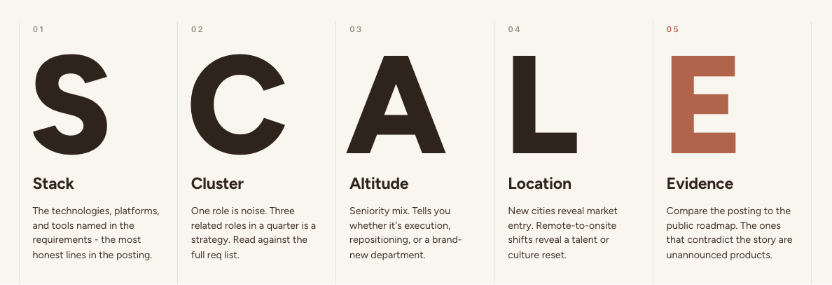
When a new role appears, we run it through five questions. We call the framework SCALE.
Stack. Look at the technologies, platforms, and tools named in the requirements section. These are the most honest parts of a job description because recruiters do not have enough context to soften them. A company whose engineering postings shift from Java and Oracle to Python, Kubernetes, and Snowflake is in a platform rewrite, not a hiring spree. A shift toward specific vector databases or LLM tooling is an AI build. A shift toward payments infrastructure libraries is a billing or embedded-finance build.
Cluster. One role is noise. Three related roles in one quarter is a strategy. Always read a posting against the rest of the open requisitions, not in isolation. If you only ever read one job description at a time, you will chase a lot of ghosts.
Altitude. Seniority mix. Use the patterns from the previous section to figure out whether this is execution, repositioning, or a new department.
Location. Where the role is based and whether it is remote, hybrid, or onsite. New cities reveal market entry. Remote-to-onsite shifts reveal a talent strategy change or a culture reset. Concentration in a single high-cost metro usually reflects a specific talent pool the company is chasing.
Evidence. Compare the posting to the company's public roadmap, recent blog posts, and pricing page. The most valuable postings are the ones that contradict the public story. A role description that references a feature, market, or customer segment the company has never publicly mentioned is usually an unannounced product. Those are the signals you want most.
Signal confidence: what to act on and what to ignore
Not every change deserves a battlecard update. We use three tiers.
High confidence. Multiple related postings in the same product area, spread across engineering, product, and marketing, inside a single quarter. If you see three ML roles, a data infra role, and a PMM with "AI" in the description, that is a high-confidence AI push.
Medium confidence. A single senior role in a new area, a clear stack change inside one team, or a new geography on one requisition. Worth logging and worth watching for confirmation in the next month of postings.
Low confidence, usually ignore. A single junior role. Generic job descriptions that could fit any team. Intern and contractor requisitions. Evergreen roles that have been open for six months and never seem to close. Replacement hires on their own.
Before you call anything a signal, set a baseline. A team of two hundred engineers always has fifteen to twenty roles open at any moment. That is attrition, not strategy. Spend the first month watching a competitor without drawing any conclusions, and the rest of the year becomes much easier to read.
The weekly workflow
The framework is useless if you do not run it on a cadence. Here is the loop we run at Meertrack against our top competitors, and that we recommend to any team trying this for the first time.
- Pick three to five direct competitors. More than five and the signal gets diluted. Fewer than three and you will not see patterns across the industry.
- Find the canonical careers page for each one. Most companies publish through Greenhouse, Lever, Ashby, or a self-hosted /careers page. Use that source directly rather than LinkedIn, which lags by days or weeks and strips technical detail out of the description.
- Capture a baseline snapshot. Number of open roles, department breakdown, locations, seniority mix. This is the reference point against which every future change gets measured.
- Check weekly. New roles, removed roles, changed titles, changed locations, and changed stacks are all worth logging. Removed roles matter almost as much as new ones, because a role that comes down after two weeks usually means the hire landed, and that tells you the clock has started.
- Log each meaningful change in a simple table. Date, competitor, role, department, seniority, location, technologies, and a one-line note on what it probably means.
- Roll up monthly. Group the entries into a short memo. What did each competitor hire for this month, and what does the cluster predict?
- Route the memo to the people who need it. Sales for battlecards, product for roadmap context, marketing for positioning, founders for strategic decisions.
An honest aside. We tried to run this workflow in a spreadsheet for six months. It worked for about three weeks, and then it quietly died every time a launch week or a sales sprint hit. The spreadsheet is the right model. It is also the wrong tool, because keeping it alive is a part-time job that no one on a small team actually has.
Two examples of the framework in action
Example one: the enterprise pivot no one announced
A forty-person SaaS company had been selling self-serve for years at $29 per seat. Over one quarter, their careers page added a VP of enterprise sales, two sales engineers, a SOC 2 compliance lead, and a solutions architect based in the New York metro. No public mention of an enterprise tier anywhere on their site or in their changelog.
Running SCALE on the cluster: the stack picked up SAML, SCIM, and SSO language that had not been there a quarter earlier. The cluster was five related roles inside one function. The altitude was senior-heavy. The location concentrated in a single enterprise-sales metro. The evidence contradicted their public roadmap, which still talked exclusively about small-team use cases.
The prediction, nine months before it happened, was an enterprise tier starting in the low five figures. That is exactly what shipped, and the teams who had been tracking the careers page had nine months to rework their own pricing and their own enterprise positioning.
Example two: the AI feature you can see coming
A mid-market data analytics tool posted three machine learning engineers, a staff applied scientist, and a product manager whose description referenced "natural language querying." At the time, the company had no public AI product, no AI page on their site, and no mention of LLMs in their blog archive.
Running SCALE: the stack flagged LLM tooling and vector databases. The cluster was five roles tied to one capability. The altitude was a mix of senior and mid, which fit a new department being built out. The evidence completely contradicted the public story.
Six months later, an AI query assistant launched as the headline feature of their annual user conference. The teams who had been reading the careers page were not surprised, and the ones who had been reading press releases were six months behind.
Where this fits in a $100-a-month CI stack
Job posting analysis is one layer. On its own, it is powerful, and it is still a quarter of the picture. Pair it with pricing page monitoring, feature page monitoring, and messaging tracking to see how a competitor moves on every surface at once. Hiring tells you the bet. Pricing tells you the model. Feature pages tell you what shipped. Messaging tells you who they are aiming at now.
Enterprise competitive intelligence tools like Klue and Crayon do all of this. They also charge between $10,000 and $40,000 a year to do it, which is why most SMB and startup teams do not have a CI program at all. The signal is public. The problem is that reading it manually every week does not scale past about two competitors before something more urgent takes the hour back.
How Meertrack automates this
Meertrack monitors competitor careers pages alongside pricing, product, and messaging pages. When a new role goes up, we detect it within hours, summarize it with AI, and push a one-line alert to Slack or email. The alerts are filtered so that junior roles, template requisitions, and evergreen postings do not clutter the signal. What lands in your inbox is the cluster, not the noise.
Pricing is $19 per month per competitor tracked. There is no enterprise tier, no contract, no procurement call. The free trial covers up to three competitors for fourteen days, which is enough time to see a real hiring cluster emerge from at least one of them.
If you would rather read your competitors' roadmaps than their press releases, start a free trial below, add your top three competitors, and see what their job postings are telling you this week.