
How Many Competitors Should You Track?
Tracking 3 to 5 core competitors is a safe range for most. Find the number better suited for your business by sorting your competitors into three tiers.

Contents
TL;DR: Tracking 3 to 5 core competitors is a safe range for most. Find the number better suited for your business by sorting your competitors into three tiers:
- Core (3 to 5): in your active deals right now
- Same problem, different solution (1 to 2): shows up for some buyers
- Risers (1 to 2): gaining ground but not in your deals yet
Go past ten and the noise problem comes back. The count is what's left after the filter, not something you choose up front.
You've just been told to keep an eye on the competition. Maybe a board member asked what the field looks like. Maybe a deal slipped and the post-mortem pointed at a rival. Maybe a "did you see what they just shipped?" message landed in a channel and stuck. Whatever sent you here, your first instinct is probably to ask how many and go hunting for the right figure, as if there's a count that, once you hit it, means you're doing this correctly. That's the wrong first move. The number isn't the thing you decide. It's the thing left over after you decide something else, and chasing it first is how people end up with a sprawling spreadsheet of names they'll never open again. If a lost deal is what put you here, you already have a thread to pull, and it isn't a number.
The number is the last thing you decide
You don't choose how many competitors to track; the count is the residue of a filter you apply first. Pick a number up front and you're left with two bad options. You invent a count that feels responsible, then scramble to find that many names worth the slots, half of which never mattered. Or you can't justify any figure, so you stall, and "keep an eye on competitors" stays a sticky note for another month. Both come from treating the size of the list as the thing to decide. It isn't.
This is also why the existing advice leaves you stuck. Most guides split into two camps, and neither finishes the job. One camp dodges: the answer is "it depends," followed by several thousand words on why competition is contextual, which is true and useless to anyone starting from zero. The other camp hands you a taxonomy, a tidy set of boxes labeled direct, indirect, and the up-and-comers, and tells you to fill them. The boxes are fine. The problem is that nobody tells you who goes in them, with no test for whether a given company qualifies in the first place. So a reader with no list still has no list, now with vocabulary. The taxonomy describes the shelf; it never tells you which jars belong on it. Decide who qualifies, and the count falls out as a byproduct. That decision is one test, and it takes about five minutes.
The one test: does it show up where deals get decided?
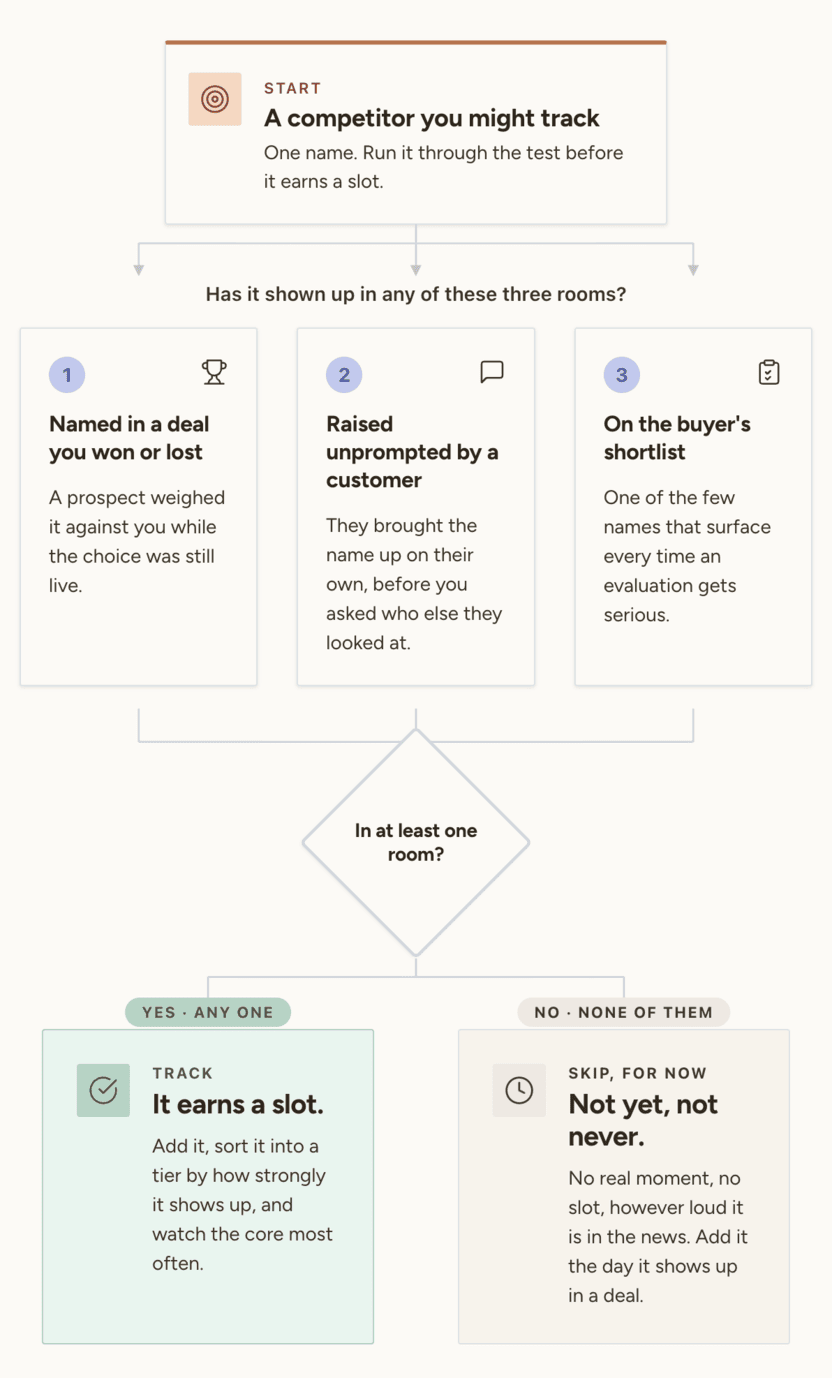
A competitor earns a slot only if it has shown up in a real buying moment. That's the whole filter, and it's a pass/fail question you can ask about any name: has this company actually appeared where someone decides whether to buy from you or from them? Whether it could compete, or sits in the same category, doesn't count until it clears that bar.
There are three rooms where "shown up" counts. First, it got named in a deal you won or lost, where a prospect weighed it against you and the choice was live. Second, a customer or prospect brought it up on their own, unprompted, not because you asked who else they were looking at, but because the name was already on their mind. Third, it sits on the shortlist your buyer is comparing when they evaluate you, the two or three names that come up every time the conversation gets serious. One of those three, and the company is in the room. None of them, and it isn't, however loudly it shows up in your industry's news.
Picture a small B2B SaaS that schedules field technicians. Two big names dominate the trade-press headlines, so they feel like the competitors. But every prospect who churns or hesitates keeps naming the same scrappy mid-market product, and that one never makes the headlines. The headline names aren't in the room. The one prospects keep raising is. The filter tells you to track the third and skip the first two, which is the opposite of what the news cycle would tell you.
Starting from zero with no deal history changes the inputs, not the test. You still have two or three customers or prospects, even if it's a handful of early conversations. Ask them directly: when you were deciding, who else were you looking at? Then search your own category the way a buyer would, using the words a buyer would type, and note which names keep surfacing on the comparison pages and in the "X vs Y" results. Those two moves rebuild the rooms from the outside. If you still can't point to a single real moment where a company showed up against you, it doesn't earn a slot yet. Not never, only not until it does.
Now sort the survivors: not every name earns the same attention
Whoever passed the filter isn't one flat list; they sort into three tiers by how strongly they show up in the room. The tiers aren't boxes you fill in advance. They're degrees of the same thing the filter measured.
Tier one is your core: the names in your active deals right now, the ones a prospect compares you against when money is on the table. There are usually 3-5 of these, because a move from any of them changes a deal you're actually working. Tier two is the same problem solved a different way, a rival that shows up for some buyers but not the ones at the center of your market, the alternative a particular type of customer raises. Expect 1-2. Tier three is the riser: the company climbing toward the room but not in it yet, the one starting to surface in a deal here and there, gaining the kind of ground that means it'll be a tier-one problem before long. Again, 1-2.
Here's where we part ways with the usual advice, which tends to call tier three the aspirational market leader, the giant you study and want to copy. We'd cut that. A big-name incumbent that never appears in your deals hasn't earned a slot for being famous, and watching it feels productive while teaching you almost nothing about the deals you're losing. Tier three is the riser, not the household name. Movement toward your rooms earns the slot; being big or admired doesn't. Attention follows from there: the core list is worth a regular look, and everything below it far less often.
So how many is that?
Run the filter and sort the survivors, and the count lands at roughly 3-5 core, five to nine total. The numbers aren't magic. They fall out because a buyer only weighs a few real alternatives at once when they're deciding, and most companies that call themselves your competitors never show up in that moment at all. It's the same instinct you bring to your own purchases: by the time a decision is close, the real contest is down to two or three names, and the rest were never serious. The list is short because the room is small. Push past ten and you've rebuilt the exact noise problem you came here to avoid, a feed of activity from companies whose moves never touch a real deal, which is the thing that makes people stop reading their own competitor updates. Worth naming the tension plainly, since it cuts against our own interest: we sell competitor tracking and charge per competitor, so a longer list would pay us more, and we're still telling you to keep it short, because what makes tracking work isn't the length of the list, it's how much noise you keep off it.
Start with the list you can defend today
The list you can defend right now is the only one worth building, so build it today. Write down the companies that have shown up in a real deal or a real conversation, sort them by how strongly they showed up, add the one riser you're watching, and stop. That's your list, and it's defensible because every name on it earned its place in a moment you can point to. You don't need to map the whole market first, and you don't need to wait until you feel finished. When a new company shows up in a real deal, add it then, on the evidence, the same way every other name got there.